Change Doesn't Live in One Room: Why Humanitarian Transformation Needs the Whole House
The humanitarian sector is changing faster than at any point in recent history. Funding cuts are forcing organisations to shrink, merge teams and close offices. Reform agendas are changing how agencies work together. Localisation is shifting where decisions are made and who makes them.
For many organisations, organizational or team restructuring is now an ongoing process rather than a one-off event. Yet change is still too often managed by separate functions. HR runs the restructure. Communications drafts the announcement. Learning schedules training once the new structure is in place. Each team works hard, but each works behind its own door.
At House of HRiE, we think of humanitarian people systems as a house with six interconnected rooms: Systems, Learning, Change, Communication, Wellbeing and Pathways.
Each brings different expertise. But organisational change doesn’t happen within a single function, and neither should we manage it that way.
Why the whole house matters
A colleague in a field office doesn't separate the all-staff email from the new job description, revised reporting line or training invitation that arrives three months later. They experience it all as one thing:
What is happening to my job, my team and the people we serve?
When these areas aren’t connected, problems appear quickly. Messages contradict each other. New roles are introduced without the skills to perform them. Career routes disappear. Stress builds, trust erodes, rumours fill the gaps and experienced people start leaving.
In humanitarian organisations, the stakes are higher still. Unclear responsibilities, delayed decisions and lost institutional knowledge can affect critical programme delivery and relationships with communities and local partners.
Crises don't pause while an organisation restructures.
Localisation adds another dimension. Moving decision-making closer to communities requires more than changing reporting lines. It means reconsidering authority, investing in local capability and creating meaningful opportunities for national staff to develop and lead.
These are connected challenges, not separate workstreams.
How do the six rooms work together in practice?
Consider a humanitarian country office facing a significant funding reduction requiring restructuring. The Systems Room establishes the what: it helps redesign the structure, policies, processes, clarify responsibilities and review workforce requirements. But even a well-designed structure can struggle if people aren't prepared or supported to work within it.
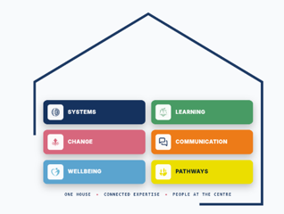
Learning prepares people for changed responsibilities and helps managers support their teams. It builds the capability to succeed in new roles and ways of working. If training arrives after implementation, people may be expected to perform differently before they have developed the necessary skills.
Communication creates shared understanding through honest, consistent and two-way dialogue with staff. It helps people understand what is changing, when and how, including difficult decisions, what remains uncertain and how they can contribute.
Wellbeing addresses the psychosocial risks that come with changing roles, increased workloads and concerns about job security that add pressure to people already working in demanding environments. Building care and wellbeing into the change process from the outset helps identify risks early and ensures teams have the support they need throughout the transition.
Pathways keeps the future visible: explores redeployment, career development, mobility, mentoring, leadership opportunities and transitions into new roles, particularly for national staff. When restructuring removes existing routes without considering what comes next, organisations risk losing valuable talent.
Change helps the whole house move together. It connects decisions about systems and structures with the people affected. It assesses how different groups will be impacted and identifies readiness gaps, ensuring that engagement, learning, wellbeing and career development are considered and coordinated throughout implementation. The Change Room helps keep the doors open, but every room shares responsibility for making the transition work.
The objective isn't simply to deliver a new organisational chart. It's to help people navigate the transition while protecting the organisation's ability to deliver its humanitarian mandate.
What experience has taught me
Having worked on organisational, HR and digital transformation programmes across the UN system and international development sector, I've learned that writing the strategy is often the easier part. Making it real means connecting systems, capability, communication, leadership and career development.
I've seen how easily organisations focus on the visible milestone—a new structure approved, a system launched, a policy issued—while underestimating the work required afterwards. A few practical lessons have stayed with me:
Alignment beats perfection. A good-enough plan that every function understands and supports will often outperform a flawless plan owned by one team alone.
Managers are the glue. Most staff experience change through their immediate manager, not headquarters. Managers need information, practical tools and support early, especially when they're navigating the same uncertainty themselves.
Silence is rarely neutral. People don't expect leaders to have every answer, but they do need to know what is decided, what remains uncertain and when they can expect further information.
Pathways are easy to break and slow to rebuild. Talent pipelines, mentoring relationships and leadership opportunities take years to establish. A restructure can remove them quickly, with the consequences only becoming visible when people leave or critical capabilities are lost.
The people supporting change need support too. HR, communications, learning and change teams often carry additional pressure while helping colleagues through difficult transitions that they are also facing. Duty of care must extend to them.
Four practical steps for organisations facing change
You don't need six separate teams or a large transformation office to apply the whole-house approach. You need people to look beyond their own function and understand how their decisions affect others.
1. Map the change and create shared ownership.
Look across all six rooms early. Ask what is
changing, who will be affected, who owns each activity and where the
dependencies are. Then bring the relevant functions together to review
progress, resolve gaps and adjust plans. A shared map and shared ownership
can prevent disconnected decisions becoming implementation problems.
2. Communicate clearly—and keep listening.
Build one
clear narrative about why the change is happening and what it means, then equip
leaders and managers to make it relevant to their teams. Create space for
questions and local perspectives, and use feedback, staff forums or short pulse
surveys to understand how the change is landing. Be clear about what can
change, what cannot and what is still uncertain.
3. Prepare people for what comes next.
Don't wait
until implementation to think about capability or careers. If roles or
responsibilities are changing, identify the skills people will need and provide
support before, during and after the transition. At the same time, make future
pathways visible—including mobility, career transitions, national staff
progression and leadership opportunities.
4. Keep people at the centre throughout.
Consider
workload, uncertainty, wellbeing and change fatigue from the outset—not once
problems emerge. Pay particular attention to managers and the HR,
communications, learning and change teams supporting others through the
transition. Keep checking whether people are not simply informed about the
change, but ready, able and supported to make it work.
A closing reflection
Humanitarian organisations cannot always control the pressures that force them to change. But they can influence how change is experienced. They can choose whether staff receive disconnected messages or a shared understanding of what is happening. Whether new responsibilities come with the skills and support needed to succeed. Whether people see only what they're losing or also understand what opportunities remain.
At House of HRiE, we believe change works better when the whole house works together: connected expertise, practical solutions and one shared purpose:
Keeping the Human in Humanitarian.
So, here's our question to you:
When your organisation changes, which rooms are working together—and which doors are still closed?
We'd love to hear your experience in the comments.
Discussion
Join the conversation
Share a response, question or perspective on this insight.
Change / 5 min read
Change Doesn't Live in One Room: Why Humanitarian Transformation Needs the Whole House
The humanitarian sector is changing faster than at any point in recent history. Funding cuts are forcing organisations to shrink, merge teams and close offices. Reform agendas are changing how agencies work together. Localisation is shifting where decisions are made and who makes them.